Optimisation of multi-rotor wind turbines for reduced cost of energy and environmental impact

Abdirahman Sheik Hassan, Neha Chandarana, Rainer Groh, Terence Macquart

The Big Picture

Multi-rotor wind turbines (MRWTs/MRs) are a promising solution to many of the problems facing the wind energy industry in its mission to scale up renewable capacity and address the ongoing climate crisis. MRWTs use an array of smaller rotors on one support structure, as shown in Figure 1, in place of the ever-growing single-rotor concept. The inherent scaling advantage of this architecture can offer significant mass and cost savings, while simultaneously alleviating challenges in transportation, manufacture and aeroelastic stability associated with large wind turbine blades. From the launch of the OceanX dual-rotor platform in China, to the planned construction of the Wind Catching demonstrator in Norway, the concept is moving up the technology readiness levels from theoretical economies of scale to practical solutions. While these demonstrators will shed light on the practical feasibility of the concept, little is known about the true extent of the benefit it can offer over the existing single-rotor paradigm.

Figure 1: Mingyang OceanX dual turbine platform [1] and Wind Catching System’s Wind Catching Demonstrator model [2].
Our Research Aim

Our work aims to provide further confidence in the feasibility of the multi-rotor concept through detailed modelling, analysis and by employing coupled aeroelastic optimisation to minimise the levelised cost of energy. We recently published a review on multi-rotor technology (tinyurl.com/4b4pnypm) and highlighted the need for comprehensive design studies to quantify the benefits of the multi-rotor concept in comparison to conventional designs.

An Open-Source Library to Support Research in the Multi-Rotor Concept

To address this gap, the ATOM aeroelastic software package from the University of Bristol has been expanded to model and design MRWTs, using blade element momentum theory coupled with multi-body dynamic finite element analysis. Enabling this process requires detailed virtual rotor models fit for the MR context. We tackled this problem with our recent work presented at the Multi-Rotor Seminar in Hamburg (tinyurl.com/4vpwbp64) on the generation of an open-source library of reference rotors for use in MRWT modelling. Optimised rotor models with ratings ranging from 100kW to 1MW are generated and shared in the OpenFAST format, allowing researchers to study and compare a large range of multi-rotor configurations.

Holistic Concept Design

Aiming to achieve a “globally optimised” MRWT, the individual rotor-level optimisation enables the assessment of optimal rotor number for a given overall rated power. Figure 2 demonstrates the use-case of these models – the ability to assess the optimal number of rotors by rapidly exploring a large number of different configurations with detailed rotor and support structure models.

Figure 2: Multi-rotor models constructed using rotor designs from the rotor design library. These include three 1 MW rotors, fifteen 200 kW rotors and seven interpolated 428.6 kW rotors.

An Opportunity for Greener Wind Energy

Working in collaboration with the National Composites Centre we are exploring the potential of MRWTs as an enabling technology for the use of sustainable materials in wind turbine blades, due to their smaller rotor size and reduced structural requirements. Ongoing work investigates the dual-objective optimisation of the rotor models in the rotor design library for the minimisation of both cost of energy and environmental impact.


[1] Mingyang Smart Energy. Retrieved October 2nd, 2025, from https://en.myse.com.cn/

[2] Wind Catching Systems. (n.d.). Retrieved September 23, 2025, from https://www.windcatching.com/

BCI develops composites manufacture simulation software: SimTex

SimTex is a fast simulation software developed at the BCI for composites manufacture. It contains modules for simulating 2D/3D weaving, braiding, filament winding and forming. SimTex can predict the as-manufactured component geometry and identify the onset of defects, thereby helping to enable right first time manufacture in prototyping of composites parts. It is currently deployed across a number of industry projects to support composites design for manufacture.

If you are interested to learn more about the SimTex software, please reach out directly to Stephen.Hallett@bristol.ac.uk.

InVIsion Carbon, an NCC Technology Pull-Through Project: In-process NDT for Higher Quality and Rate Automated Composites Manufacturing

Ege Arabul (BCI, University of Bristol), Per Saunders (Metrology, NCC), Robert Hughes (UNDT, University of Bristol) 

As industries like aerospace, automotive, and renewable energy increasingly rely on high-performance carbon fibre composites, ensuring these materials are made perfectly – without defects – is more important than ever. 

Current inspection methods mostly rely on visual checks or tests carried out after manufacturing is complete, when fixing problems is too late. 

Our team at the Bristol Composites Institute (BCI), working with the National Composites Centre (NCC) and the Ultrasonics and NDT (UNDT) research group, has developed a new type of sensor that can spot issues during manufacturing, before the part is finished when remanufacture is more easily performed. 

This Bi-directional Differential Eddy-Current Testing (ECT) Sensor uses the natural conductivity of carbon fibres to detect changes in how the fibres are laid down, revealing tiny gaps, overlaps, wrinkles, and other defects in real time. 

We’ve successfully tested the sensor within the Hydrogen Tank and Automated Tape Laying manufacturing cells at the NCC, where it was able to identify and help correct defects as they appeared – saving time, reducing waste, and improving production quality. 

This innovation marks a major step toward real-time, in-process inspection in composite manufacturing, cutting out costly post-production testing. 

The work now continues within the FENDER project, where we’re inviting industry partners and researchers to join us in shaping the future of smart, automated composite manufacturing. 

Freezing Failure: Understanding failure of composites at cryogenic temperatures

by David Brearley

The advancements of magnets used in magnetic resonance imaging (MRI) have led to the incorporation of glass fibre reinforced polymer (GFRP) rings being adhesively bonded between epoxy-infused coils of superconducting wire. The two components respond differently to various loading conditions, potentially leading to structural failure. The magnet’s structure is integral to its’ performance as large electromagnetic forces (EMF) are induced due to the strong magnetic field present, under cryogenic temperatures. Unintentional quenches can be triggered by localised heat generated by friction or crack propagation. This results in Ohmic heating, boiling the surrounding liquid helium and potentially causing permanent, catastrophic damage to the magnet.

At the Bristol Composite Institute, the deformation and failure modes of an MRI magnet during operation were investigated by developing an experimental methodology for applying thermomechanical loads to test coupons, effectively mimicking MRI magnets in use. A simple finite element (FE) model of the magnet was constructed to assess the operational stress state and showed that high bi-axial stress concentrations were predicted around the adhesive bond between the coils and GFRP spaces.

To investigate how this could lead to structural failure, a Modified Arcan Fixture (MAF) as shown in Figure 1 was implemented. Several loading hole pairs were used to induce various compression-shear stress states in specimens that contained the adhesive joint cut from a full magnet. In the development of the experimental methodology, a more predictable bonded structure was manufactured using the coil infusion resin as an adhesive to simultaneously evaluate the epoxy’s isolated load response and refine the experiment. Tests were carried out at room and cryogenic temperatures so the thermomechanical load carrying capability of the bond could be evaluated.

Constant cryogenic cooling during quasi-static loading was achieved with the development of a novel modular cryostat that isolates the region around the adhesive bond from the rest of the fixture. The implementation of this cryostat facilitated the use of digital image correlation (DIC) to continually record the specimens’ full field response to the load at cryogenic temperatures, using just boiled pressurized nitrogen as the coolant. Based on a concept from NCC, a rapid prototyping approach was used to iteratively improve the design of the 3D printed cryostat, and in doing so, achieved test temperatures down to -150oC while maintaining the necessary optical clarity.

Figure 1 – Schematic of the Modified Arcan Fixture (left) and the author conducting multi-axial tests with it (right).

This research has improved the understanding of how adhesive bonds, of a similar geometry to those found within an MRI magnet, respond to various bi-axial stress states at room and cryogenic temperatures, see Figure 2. The design process for the developed cryostat opens the door to countless potential possibilities for mechanical testing under cryogenic conditions, where complex thermomechanical stress states require advanced measurement techniques to evaluate the material’s load response.

Figure 2 – Load carrying capability of specimens containing the adhesive bond found within an MRI magnet (circles) and that of adhesively bonded steel plates (crosses, with yield profiles as dotted lines) at ambient (red) and cryogenic (blue) temperatures for various Modified Arcan Fixture load configurations: shear (α=90 ̊), compression-shear at a ratio of 1:2 (α=120 ̊), and of 2:1 (α=150 ̊ )

Bristol Composites Institute researchers explore novel joining strategy for modular wind turbine blades

Research into novel hybrid joining concepts for segmented composite blades aims to inform the development of modular wind turbine technologies, supporting the industry’s pursuit of larger, more efficient blade design solutions.

As offshore wind turbines grow larger to improve energy capture, the design of wind turbine blades faces mounting challenges. Blade lengths now exceed 100 meters, especially in offshore applications, enhancing energy capture but complicating manufacturing, transport, and assembly. Traditional full-length blade construction is costly and logistically demanding, prompting the industry to explore modular blade designs.

Image showing blade joint concept and stress flow through the joint components across a segmented blade section.

Segmentation of blades, particularly spanwise segmentation i.e. splitting the blade into manageable-sized sections along its length—has emerged as a promising solution to mitigate these challenges. However, re-joining split blade sections while preserving structural integrity and performance comparable to a monolithic blade remains a significant engineering challenge. Existing solutions like mechanical fastening or adhesive bonding offer partial relief but are hindered by trade-offs such as added weight or complex assembly procedures.

To address this challenge, a research team based at the Bristol Composites Institute, University of Bristol, has developed a hybrid adhesive snap-fit joint concept tailored for wind turbine blades. This novel design integrates the alignment and retention features of snap-fit mechanisms with the smooth load transfer capability of adhesive bonding. The resulting joint design is lightweight, scalable, and easier to assemble on site, offering a compelling alternative to conventional joining methods.

This innovative hybrid joint is designed in such a way that the joint components are embedded into the critical load-bearing spar cap region of the blade, where it redirects load paths through the snap-fit joint features while preserving the aerofoil’s outer geometry. Maintaining the external blade profile allows the joint to be incorporated without compromising aerodynamic performance or requiring major design alterations to existing blade moulds, thereby supporting backward compatibility with current manufacturing processes.

Advanced finite element analysis (FEA), incorporating anisotropic composite material models and failure criteria, has demonstrated the joint’s ability to handle extreme load conditions representative of a 10 MW reference blade.  The results showed that the joint can sustain design loads without material failure all while introducing less than 1% additional weight compared to a monolithic blade, representing a significant improvement over conventional joining methods. While further investigation is needed, including prototype building and fatigue loading evaluation, this study represents a significant step toward scalable and manufacturable joint solutions for modular wind turbine blades.


Further Information:

The hybrid adhesive snap-fit concept has broader relevance and could inform future joining strategies for composite structures across other engineering applications. Realising its full potential, including prototype development, will require collaborative efforts, and the research team welcomes engagement from industry and academic partners interested in advancing this work toward practical implementation.

Research Team:

Muhammad Basit Ansari, Dr Vincent Maes, Dr Terence Macquart, Dr Eric Kim, Dr Alberto Pirrera To learn more or explore collaboration opportunities, please contact

Muhammad Basit Ansari

basit.ansari@bristol.ac.uk

BCI PhD Student Wins SAMPE UK Competition

We are proud to announce that PhD student Nicolas DARRAS has won the 2024 SAMPE UK & Ireland Student Seminar Competition, alongside Badr Moutik from University of Plymouth.

Nic’s presentation titled “Investigation on the manufacture of hierarchical composites and their mechanical compressive performances” impressed the judges and a result he will be representing SAMPE UK at the SAMPE Europe competition (part of the SAMPE Europe conference taking place in Belfast in September).

Nic said “Participating in the SAMPE Student Seminar competition was a tremendous experience, allowing me to enhance my presentation skills and shine a light on the novel research within the NextCOMP programme. As one of the UK representatives, I eagerly anticipate the SAMPE Europe conference in September, where I’m excited to showcase our innovative projects on an international stage.”

Tim Wybrow, SAMPE UKIC Chairman, said, “I am really impressed with all the student researchers this year. We have decided as a committee that as a congratulations and thank you for their efforts, each participant will be offered a complimentary one-year membership to the organisation.”

How can experienced professionals find research projects in their niche area?

Many experienced professionals can easily find research projects in their niche area, but young PDRAs and PhD students may not know how to find them. Research projects can offer opportunities for learning, networking, and career advancement. However, finding research projects that match one’s skills and interests can be challenging. For that reason, we will introduce some strategies and resources for finding research projects in your niche area.

  1. Identify your research interests and skills.

Identifying your research interests and skills involves introspection into your academic background, personal passions, and career objectives. Questions like, “What are the primary themes or issues that captivate me?” and “What gaps or challenges exist in my field of study?” can guide this reflection. Additionally, consider the skills or methods you enjoy using or learning, and ponder how you wish to contribute to the progress of knowledge or society.

To pinpoint your research interests and skills, explore diverse sources of information and inspiration. This may include perusing academic journals, books, or websites pertinent to your discipline. Seek input from current or past professors, colleagues, or peers who share your interests. Delve into online databases or platforms listing research opportunities or projects and explore professional associations or networks offering guidance for researchers.

To find meaningful projects, look for titles such as research assistant, research officer, or research specialist in relevant fields. Utilize keywords when searching on platforms like LinkedIn and ResearchGate to discover valuable opportunities.

  1. Explore existing research projects and opportunities.

One of the crucial skills for a researcher is the ability to investigate existing research projects and opportunities. This skill aids in discovering new collaborators, recognizing gaps in the literature, and identifying potential funding sources. Here are some suggestions on how to explore existing research projects and opportunities:

– Utilize online databases and platforms that aggregate research information, such as Google Scholar, ResearchGate, Scopus, and others. Conduct searches based on keywords, topics, authors, institutions, or citations to locate pertinent research papers, projects, and researchers.

– Attend conferences, workshops, seminars, and webinars aligned with your field of interest. Stay informed about the latest developments, trends, and challenges in your research area while networking with fellow researchers who share your interests. Additionally, consider presenting your own work to receive feedback from peers and experts.

– Join professional associations and societies that represent your research domain. Gain access to their publications, newsletters, events, and membership directories. Participate in committees, working groups, or special interest groups to contribute to their activities and initiatives.

– Initiate contact with potential mentors, advisors, or collaborators working on topics or methods that intrigue you. Reach out through email, social media connections, or request a meeting to inquire about their current or past projects, research goals and challenges, and seek advice.

– Explore your institution’s research resources and opportunities. Check your department’s website, bulletin board, newsletter, or email list for information on ongoing or upcoming research projects, events, grants, or awards. Engage with colleagues, supervisors, or administrators to learn more about their research interests and activities.

  1. Research out to potential collaborators and mentors

One of the key skills for a researcher involves reaching out to potential collaborators and mentors who can provide valuable feedback, guidance, and opportunities. However, many researchers face challenges in initiating and maintaining such professional relationships. Here are some effective tips for conducting research outreach:

– Clearly define your goals and interests before reaching out to anyone. Determine what you aim to achieve through collaboration or mentorship and what you can contribute in return. Whether it’s learning a new method, working on a specific project, or seeking career advice, consider how you can contribute to their research or objectives.

– Conduct thorough research on the individuals you intend to contact, including their background, publications, and current projects. Tailor your message to reflect your genuine interest and enthusiasm, and identify common connections, such as mutual colleagues, institutions, or interests, to establish rapport.

– Craft a concise and polite email for your initial contact. The first impression is crucial, so ensure your email is well-written, professional, and respectful. Briefly introduce yourself, explain the purpose of your contact, articulate what you hope to gain from the interaction, and inquire about their availability and preferred mode of communication. Be specific about your request yet remain flexible and considerate of their time and priorities. If relevant, attach your CV or portfolio, and provide a link to your website or profile.

– Follow up and maintain communication. If you don’t receive a response within a reasonable time frame, consider sending a gentle reminder or follow-up email after a week or two. However, avoid being overly persistent or pushy to prevent annoyance or pressure. If they agree to a conversation, prepare questions or topics for discussion, and be punctual, courteous, and attentive during the conversation. Express gratitude for their time and insights and follow up with a thank-you email afterwards. If they suggest any action items or next steps, promptly follow through and keep them informed of your progress.


For more information, feel free to contact the BCI internal newsletter team at uob-bci-internal-newsletter@bristol.ac.uk

Industrial Doctorate Centre in Composites Manufacture: Showcase 2023

The Industrial Doctorate Centre welcomed over 40 guests to the annual Showcase event, on the 19th September 2023, held at the Watershed in Bristol. The event was followed by a gala dinner at Bristol Harbour Hotel.

The Industrial Doctorate Centre in Composites Manufacture has now reached its 10th year, and over this time, 31 students have graduated with an EngD in Composites Manufacture. The day before the event we welcomed five new students to the IDC, bringing the total number of students currently enrolled to 20. The new students were excited to attend the Showcase along with existing IDC students, alumni, academic and industrial supervisors, and joined by a group specially invited  VIP guests, with strong connections to the UK composites sector. It was a great opportunity for students to present their research work to a wider audience and network within the industry.

The day consisted of 3 oral presentations sessions and a quick-fire poster session all chaired by the IDC alumni. The presentations from our students ranged from topics in advanced manufacturing techniques, new approaches to testing wind turbine blades, process simulation and effect of cryogenic exposure on composites. A focus of the showcase was sustainability, this was brought in to context in a fantastic keynote speech from Dr Ffion Rodes. One of the ambitions for the IDC is for our students to create their own spinouts and companies. Dr Tomasz Garstka a PhD alumni from Bristol Composites Institute has done just that creating his company LMAT. Tomasz gave an excellent keynote presentation  on how he turned his academic research into a commercial tool for composite tooling.


The Showcase ended with a very lively panel discussion, chaired by Professor Mike Hinton of the High Value Manufacturing Catapult. The panel comprised  Dr Anna Scott Magma Global; Dr Petar Zivkovic Airbus; Dr Peter Giddings NCC; Dr Faye Smith, Avalon Consultancy; Professor Paul Hogg, Royal Holloway University of London; Janet Mitchell, MC2Consultants.

The panel were asked to discuss how can industrially-based doctoral research help unlock the potential of composites in achieving a Net Zero? The topics discussed included: Understanding better how digital technologies can help accelerate our learning; start thinking of composites as an enabler to protect our way of life by integrating sustainability at the design stage, creating a template for LCA that can be used in all projects; extended in-service life of composites and life extension programmes; smarter testing to reduce waste and move to virtual tests for certification; take steps to eliminate trial and error approaches in manufacturing; move away from the driven by rate approach.

The event was a great success with engaging discussions throughout the day carrying on into the evening at the reception and the gala dinner.

Professor Janice Barton, Director of the IDC was delighted with the day and said “It was fantastic to see our students present their work with confidence and realising they are making a significant difference to their sponsoring companies and to wider society”.

Process Simulation For Reduced-defect Composites

by Siyuan Chen, Stephen Hallett and Jonathan Belnoue.


As the demand for carbon fibre-reinforced composites structures is rapidly growing, the industrial community continues to seek new manufacturing technologies that are low-defect, low-cost, highly efficient and environmental-friendly. Liquid molding is regarded as a cheaper alternative to the traditional prepreg/autoclave approach, however, the latter is often the favoured manufacturing route in the aerospace sector (where safety is paramount) as it allows for the production of better quality parts. One of the many challenges with infusion is the high deformability of the dry fibrous precursor materials that exposes the final structure to risks of defects and part to part variability. If the material and process (including their variabilities) are not controlled to a sufficient level, meeting design tolerances can prove challenging. These risks are traditionally mitigated through “over design” but this reduces a lot of the lightweighting advantages of using composites. 

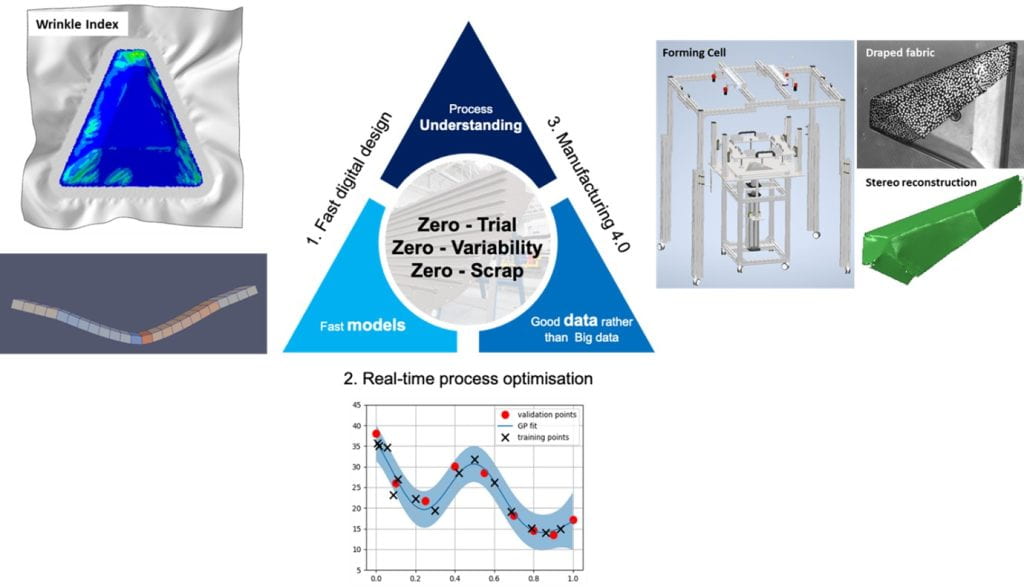
At BCI, we explore the possibility of achieving reduced-defect forming processes in 3 different ways. Firstly, design tools accounting for manufacturing constraint that are faster than current methods available commercially are being developed [1, 2]. These tools can be used to run moderate numbers (i.e., up to a 100) of simulations and allow to explore the impact of different combination of process control parameters on final part quality. This provide the possibility of optimising the forming process. The robustness of the optimisation is then improved by building Gaussian process (GP) emulator using the dataset produced using our fast simulation tools [3]. These GP emulators can achieve a good accuracy (error < 10%) and model the impact of several input parameters by running only tens of simulations. By introducing dimension reduction and active learning algorithms, the emulators can be expended to much more complex processes with over 10 input parameters [4]. After being trained, the emulators can also provide immediate predictions for final part quality. This open the door for digital twinning where in-process sensing and real-time simulation are combined. Thus, although forming processes can be optimised using deterministic FE simulations, real-world cases are affected by lots of factors such as material and process variability. Some of these variabilities are difficult to avoid but can be measured. Quantifying them (e.g., fibre direction misalignment, tow waviness, etc), a feedback loop whereby real-time simulations are informed by live data of the process and used to adapt the manufacturing condition to improve the final part quality can be set. A forming test cell instrumented with a stereo imaging system is currently being built in our labs. This will be used to construct a prototype digital twin for forming process. 

To summarise, in our vision right first-time design and manufacture of composites can be achieved through a combination of (physics-based) digital design accounting for manufacturing constraints, fast process optimisation using data generated from process models and self-adapting manufacturing hardware controlled through emulators build from process models. 


[1] Composites: Made Faster – Rapid, physics-based simulation tools for composite manufacture (ukri.org) 

[2] JPH Belnoue, SR Hallett A rapid multi-scale design tool for the prediction of wrinkle defect formation in composite components, Materials & Design, 2020. 

[3] S. Chen, A.J. Thompson, T.J. Dodwell, S.R. Hallett, J.P.-H. Belnoue, Fast optimisation of the formability of dry fabric preforms: A Bayesian approach, Materials & Design, 230:111986, 2023. 

[4] S. Chen, A.J. Thompson, T. J. Dodwell, S.R. Hallett, J. P.-H. Belnoue. A Bayesian surrogate framework for the optimisation of high-dimensional composites forming process. In 5th International Conference on Uncertainty Quantification in Computational Science and Engineering, 2023. 

Moving cheese: energetically efficient shape shifting via embedded actuation

Compliant materials and slender structures are susceptible to a variety of different instabilities under external stimulus or loading. Traditionally, these instabilities are avoided and classified as failure modes. In recent years, researchers at the BCI have instead attempted to use complex nonlinear behaviour for novel functionality. Simply put, if nonlinearities are understood, then they can be exploited to create well-behaved nonlinear structures. In a recent publication in Physical Review B [1], we employed ‘active modal nudging’ as a novel actuation mechanism for soft robots. In essence, we programmed a soft metamaterial to shape-shift in a rapid and energetically efficient manner by employing embedded actuation to switch between different stable post-buckled modes. 

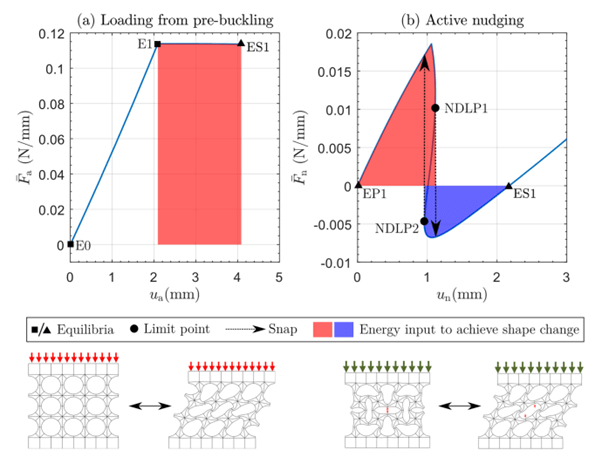
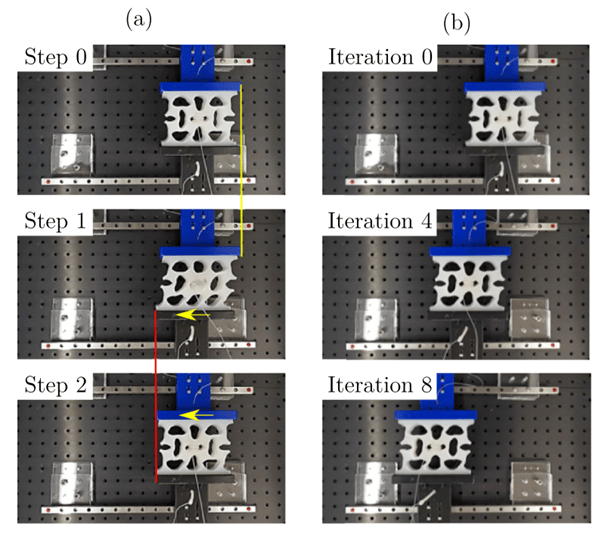
Our work focused on a latticed metamaterial consisting of an elastomeric matrix with a 3 by 3 square array of circular holes, as shown in Figure 1. We discovered that this metamaterial has three stable post-buckling modes under pure compression, i.e. two sheared modes (sheared left and sheared right) and one symmetric polarised mode. The metamaterial was programmed to favour one of the sheared modes under axial compression via modal nudging [2]. An actuator was then embedded within the central hole to trigger a mode switch between the favoured sheared mode and the polarised mode. We demonstrated that this combination of active and passive nudging is more energetically efficient and requires smaller actuation force than the more widely used global actuation method, as shown in Figure 1(a). By toggling the metamaterial between the sheared and polarised state, we were able to make the metamaterial crawl. The effective locomotion could be employed in soft robotics systems (Figure 2). 

While in this study, we consider a specific type of soft metamaterial and a specific application, the design paradigm introduced can be extended to other scenarios where energetically efficient shape shifting may be beneficial, such as lightweight adaptive wing structures or adaptive façade and ventilation systems for net-zero buildings. 

Figure 1 The actuation force–displacement curve of the lattice metamaterial to achieve a us/L = 0.20 shear displacement amplitude, using: (a) increasing compression from the pre-buckling state; and (b) active nudging from the symmetric deformation mode. 


Figure 2 (a) A typical actuation cycle for the robot. Yellow and red lines are the reference line indicating the initial and final positions of the right and left edges. The yellow arrows represent the motion of the fixture within the step. (b) The location of the crawling robot in the initial state, after four and eight iterations. A movie of the movement of the demo robot can be found in https://journals.aps.org/prb/supplemental/10.1103/PhysRevB.107.214103/DemoCrawlingRobot.mp4 


References: 

[1] Shen, J., Garrad, M., Zhang, Q., Leao, O., Pirrera, A., & R. M. J. (2023). Active reconfiguration of multistable metamaterials for linear locomotion. Physical Review B, 107(21), 214103. 

[2] Cox, B. S., Groh, R. M. J., Avitabile, D., & Pirrera, A. (2018). Modal nudging in nonlinear elasticity: tailoring the elastic post-buckling behaviour of engineering structures. Journal of the Mechanics and Physics of Solids, 116, 135-149.